
OSINT Terminology
Open source intelligence
Open source intelligence is the intelligence discipline that collects publicly available data and information, which then undergoes a production process in response to the intelligence requirements.
Open source and publicly available information
Open source is an individual, entity, medium, location, technological system, as well as any other subject or object in possession or containing publicly available data and information, accessible to the public through direct observation, on request, by subscription or obtained commercially.
This includes, but is not limited to the following overall categories:
-
overt human experts;
-
general and specialized press and the media;
-
books;
-
academic and professional publications;
-
white papers and grey literature;
-
public documents, databases and archives;
-
commercial imagery and geospatial information;
-
surface, deep and dark web, including social media and instant messaging platforms;
-
IoT devices and cameras, etc.
OSINT process
OSINT process is a systematic, repeatable or reproducible workflow, structured in distinct phases, that is designed to collect, process and produce intelligence from publicly available information, ensuring both consistency and adaptability in response to intelligence requirements.
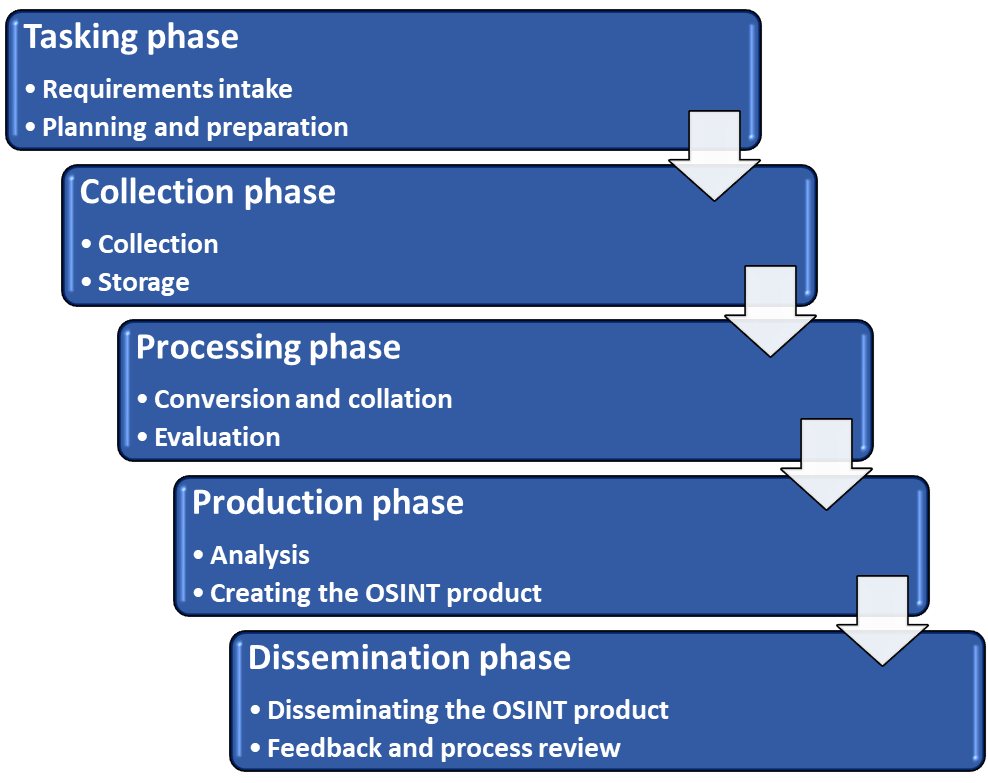
1. Tasking phase

Requirements intake
The OSINT process must be properly focused and effective, so establishing its clear objectives is vital to guide the subsequent phases of the OSINT process and ensure that every further phase is aligned with the specific needs of the intelligence customer.
Planning and preparation
This includes the proper allocation of the resources, the choice of the collection methods, the identification of sources, setting the timelines, complying with the legal requirements and ethical considerations, as well as the anticipation and address of the potential challenges.
2. Collection phase

Collection
The collection process constitutes different methods and techniques of gathering all publicly available information in accordance with the given task. It needs to be based on the principles of information traceability and reversibility.
Storage
Through the collection process, all the collected information must be stored in accordance with the metadata standards, noting the exact date, time, origin and method of collection, as well as its classification. This ensures its traceability and future re-use, having stored information accessible and searchable as necessary.
3. Processing phase

Conversion and collation
The collected information needs to be compiled, cleaned and converted into a format and language suitable for further handling. It is then collated by grouping together all its related pieces, registering it in databases or putting it in spreadsheets and tagging it with appropriate categories, according to an established and standardised set of criteria. Consequently, the collated information is sorted, filtered and organised into a fully consolidated set of information.
Evaluation
The collected information and its sources must undergo an independent process of reliability and credibility evaluation. Reliability indicates the level of trustworthiness of a source and credibility indicates the degree of validity of a piece of information.
4. Production phase

Analysis
During the process of analysis, the information is turned into intelligence, by carefully selecting, examining, categorising, structuring and putting into context the collected information, with the aim of gaining a comprehensive insight on the OSINT task in question and enhancing the quality and usability of the OSINT product.
Creating the OSINT product
The collected information has to be shaped into an intelligence product that can be delivered to intelligence customers. It has to, as fully as possible, meet the requirements of the task in question and accurately reflect the overall findings of the OSINT process.
5. Dissemination phase

Disseminating the OSINT product
The final OSINT product has to be timely and effectively disseminated to the intelligence customers in an appropriate manner. To maximise utility, using the customer-tailored formats of the OSINT products (written, visual, oral, etc.) is recommended.
Feedback and process review
An effective dissemination should create a mechanism of feedback from intelligence customers that should present the evaluation of the relevance, quality, timeliness and usefulness of the delivered OSINT products in order to provide eventual amplifications, improve future collection and enhance production efforts. In that sense, designing a standardised concise feedback template and disseminating it with the OSINT products can facilitate identifying any potential aspects for improvement and consistency of the OSINT process results.
Disclaimer: The above definitions and concepts represent the view of the OSINT Centre of Excellence and are not aimed in any way to restrict the individual member parties to use their own definitions and develop their own OSINT concepts outside of the Centre’s scope.